
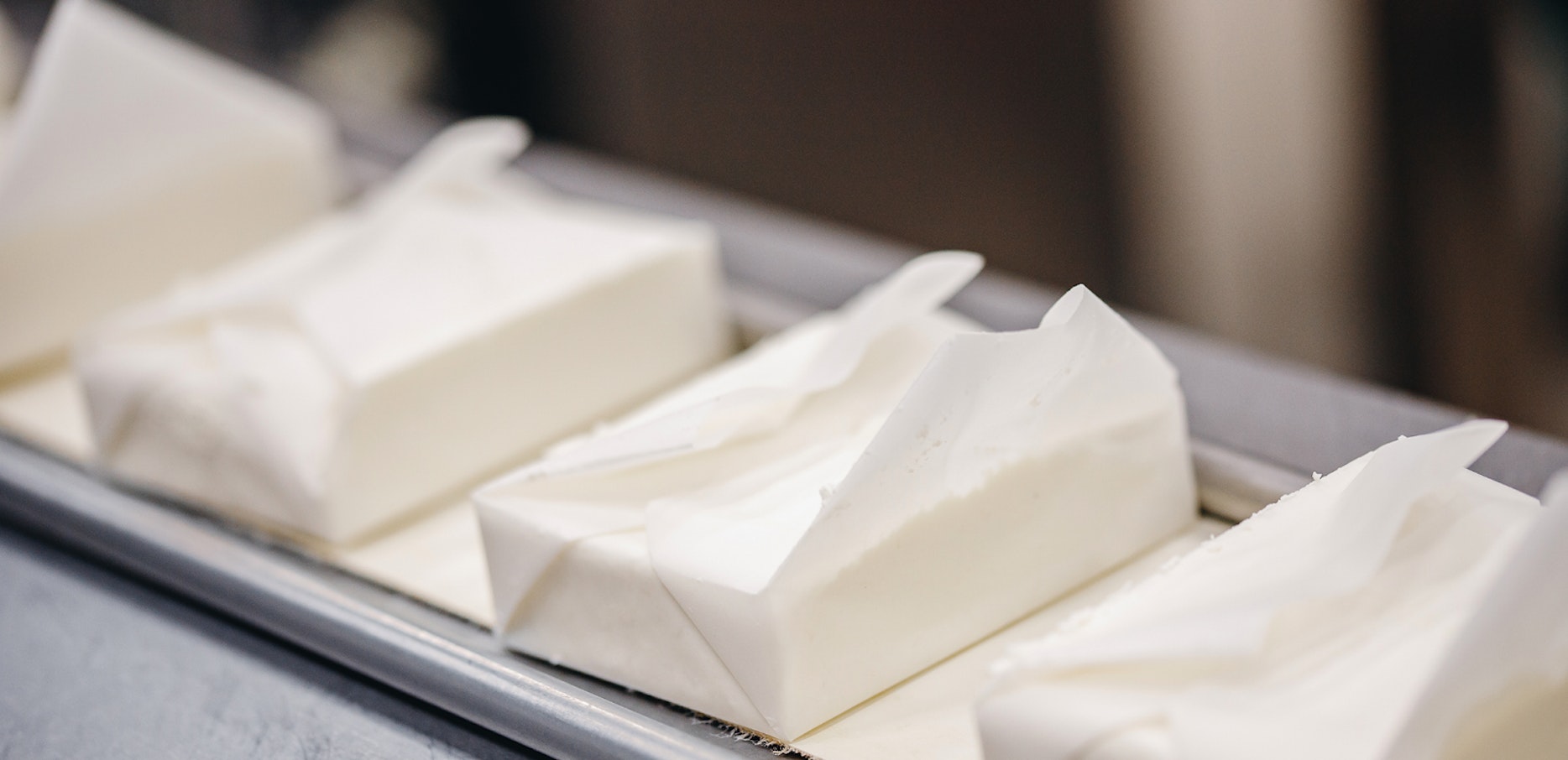
In high-volume manufacturing, cream cheese performance goes far beyond taste and consumer appeal. When production lines run at full capacity, consistency, flowability, heat stability, and machinability are critical.
Manufacturing downtime can escalate quickly. What might seem like a small inconsistency can become a major cost issue. When cream cheese fails under operational pressure, it creates challenges that affect labor efficiency and delivery commitments.
Whether you’re making thousands of cheesecakes, scaling sauce production, or operating continuous processing equipment, your cream cheese must deliver reliable performance engineered for manufacturing success.
Here’s what operations teams need to understand about cream cheese that’s truly engineered for manufacturing success.
Consistency: The Foundation of Manufacturing Excellence
Small variations may be acceptable in a lab setting, but on the production line, even minor differences can create problems. Cream cheese rheological and textural properties affect the sensory experience and physical attributes like firmness, elasticity, and spreadability.
For operations teams, consistency means:
- Predictable performance across all key parameters
- Stable viscosity across the full temperature range of your process
- Texture that stays the same batch after batch
- Standardized moisture that reduces recalibration and quality checks
This predictable behavior lets your team optimize equipment settings once rather than adjust constantly.
The global cream cheese market reached $7.23 billion in 2024, with projections indicating growth to $11.45 billion by 2034. This expansion is driven largely by food service and manufacturing applications where consistency isn’t just preferred; it’s absolutely non-negotiable for operational success.
Flowability: Engineering Continuous Operation
Flow characteristics can make or break a production run. While lab tests estimate flowability, the real test is how cream cheese performs in your manufacturing environment.
Critical flow considerations that directly impact line efficiency include:
- Pump compatibility – fluid movement without separation or clogging, maintaining consistent performance throughout extended production runs.
- Pipeline transport – consistent viscosity that prevents pressure build-up, reducing the need for manual intervention and system adjustments.
- Mixing integration – uniform distribution without over-mixing, which can compromise both product quality and processing efficiency.
Cream cheese must flow well through positive displacement pumps and automated systems to support long runs without manual intervention.
Heat Stability: Maintaining Performance Under Thermal Pressure
Manufacturing exposes cream cheese to intense heat during mixing, thermal emulsification, filling, and cooling. Without proper heat stability, cream cheese can fail when temperatures rise.
Different cheese types melt at different temperatures based on their fat and moisture. Manufacturing-grade cream cheese must retain integrity well above these baseline temperatures.
This stability isn’t just about preventing product failure. It’s also about maintaining the functional properties that your downstream processes depend on. Heat-stable cream cheese:
- Keeps structural integrity at thermal limits
- Preserves flow properties during heating
- Maintains texture throughout the thermal cycle
This ensures consistent quality and performance through demanding processing steps.
Machinability: Equipment Compatibility That Drives Efficiency
Your cream cheese should help equipment run smoothly, not hinder it. Ingredients must work with production line mixers, homogenizers, and other machinery to support consistent processing.
Key equipment compatibility factors include:
- Homogenizer performance – smooth processing without heavy pressure
- Changeover efficiency – easy cleaning and quick product transitions
- Wear characteristics – minimal impact on seals, pumps, and surfaces
Ingredients that match equipment needs reduce maintenance, extend machine life, and limit downtime. Downtime is one of the largest cost drivers in manufacturing, which makes ingredient compatibility essential.
The Manufacturing Engineering Advantage
When cream cheese is properly engineered for manufacturing applications, the operational benefits create measurable competitive advantages, including:
- Reduced downtime from consistent flow and processing
- Improved yield from predictable behavior in automated systems
- Higher quality across production runs
- Lower overall costs from efficient processing
The food manufacturing industry is evolving quickly. Automation and operational efficiency now define competitive advantage. Your cream cheese ingredient should function as a performance asset that enhances your capabilities rather than a variable you constantly have to engineer around.
Partnering for Operational Excellence
Manufacturing success depends on ingredients that perform as reliably as your equipment and operators. When every component of your operation works in harmony, the results speak for themselves in quality metrics, efficiency gains, and bottom-line performance.
Cream cheese engineered for manufacturing success supports your operational goals instead of creating challenges across your production system.
Ready to optimize your line performance? Contact our technical team to discuss how our manufacturing-grade cream cheese can enhance operational efficiency and product consistency. Let’s explore how the right ingredient partnership can transform your production capabilities.